On Tuesday, July 14, 2026, our team at 365 Security Management Group had the privilege of conducting a live firearms tactical simulation with Florida Lt. Governor Jay Collins at Decision Tactical in Sanford, Florida. The session was led by our own tactical expert, Jorge Aliaga, and covered force-on-force scenarios, decision-making under stress, threat discrimination, and close-quarters movement.
It was not a photo opportunity. It was a working range day: briefings, reps, corrections, and debriefs — the same cycle we run with our protective details, church safety teams, and school security staff.
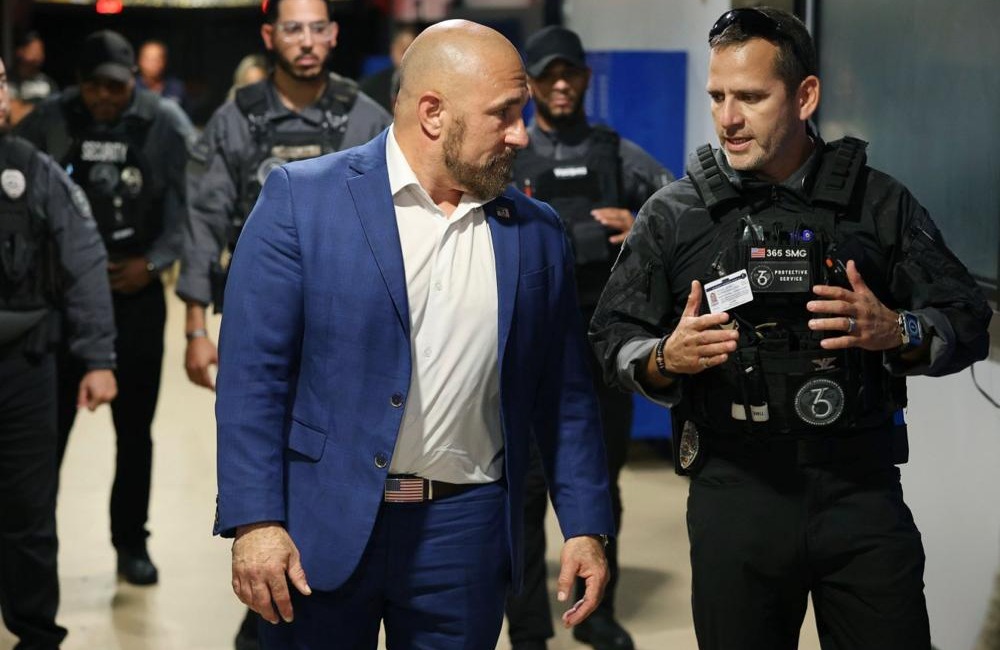
Lt. Gov. Collins and Jorge Aliaga during the pre-evolution brief.
Respect Earned, Not Given
Lt. Gov. Collins is a retired U.S. Army Green Beret — a Special Forces operator whose career spans multiple combat deployments and a level of sacrifice most people will never be asked to make. He lost a leg in service to this country and returned to keep serving: first in his community, then in the Florida Senate, and now as Florida's Lieutenant Governor.
What stood out to our team was not the title. It was the mindset. He asked operator questions, moved with intent, and treated every rep as if it mattered. That is the mark of someone who understands that skill is perishable, and that leadership under pressure is built long before the pressure arrives.
Very few public officials will put on a plate carrier and work the problem themselves. Lt. Gov. Collins did — and he did it well.
What the Session Covered
- Force-on-force simulation in a live shoot-house environment with realistic lighting, noise, and audio stress.
- Threat discrimination — identifying a lawful threat versus a bystander in fractions of a second, then being able to articulate why.
- Movement, cover, and angles — using structure to buy time instead of trading rounds in the open.
- Communication under load — clear callouts between partners while the scenario keeps evolving.
- Weapon manipulation under stress — draws, malfunctions, and reloads with an elevated heart rate rather than on a static line.
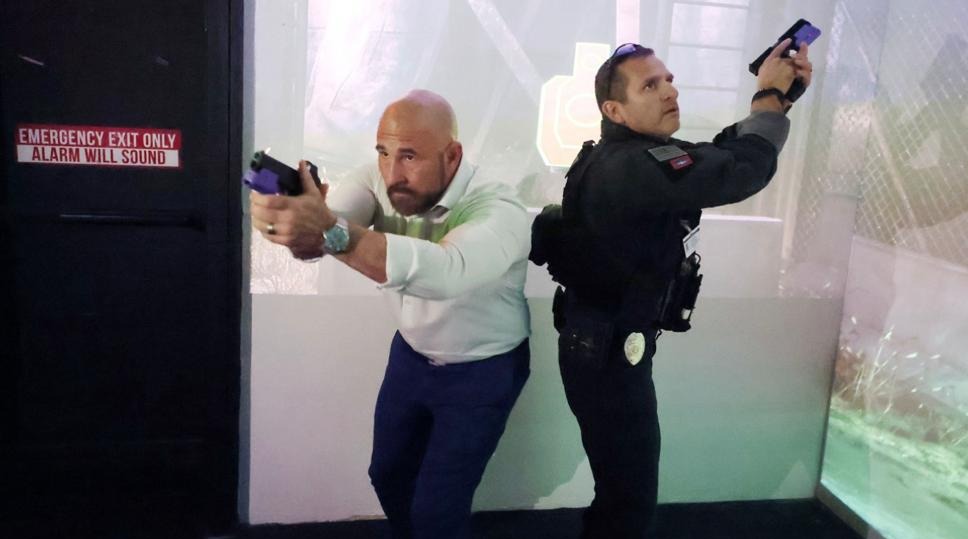
Working the shoot house: movement, angles, and threat identification under time pressure.
The 3RC Framework in Practice
Everything we ran ties back to our 3RC — 3 Range Combat methodology: the grappling range, the striking range, and the weapon range. The critical lesson is knowing which range you are actually in, because using the wrong tool in the wrong range gets people hurt.
Drawing a firearm inside the grappling range, for example, is one of the fastest ways to lose control of that firearm — and to hand a weapon to the person you were trying to stop. Conversely, closing distance to grapple when you had distance, cover, and time is a decision you will have to defend later. Scenario training is where that judgment gets built, long before it is tested for real.
Underneath all three ranges sit the same physical fundamentals we drill with every client and every officer: balance, strength, and flexibility. Technique fails first when the body is not prepared. Grip fails, footwork collapses, and the shooter starts fighting themselves instead of the problem.
Why This Training Matters Beyond the Range
The same decision-making we drilled with Lt. Gov. Collins is what protects a congregation on a Sunday morning, a campus during an active-shooter event, a hotel lobby during a hostile guest encounter, and a principal's protective detail on the move. Threats do not announce which range they intend to fight in. Teams that have rehearsed the transitions respond; teams that have not, freeze.
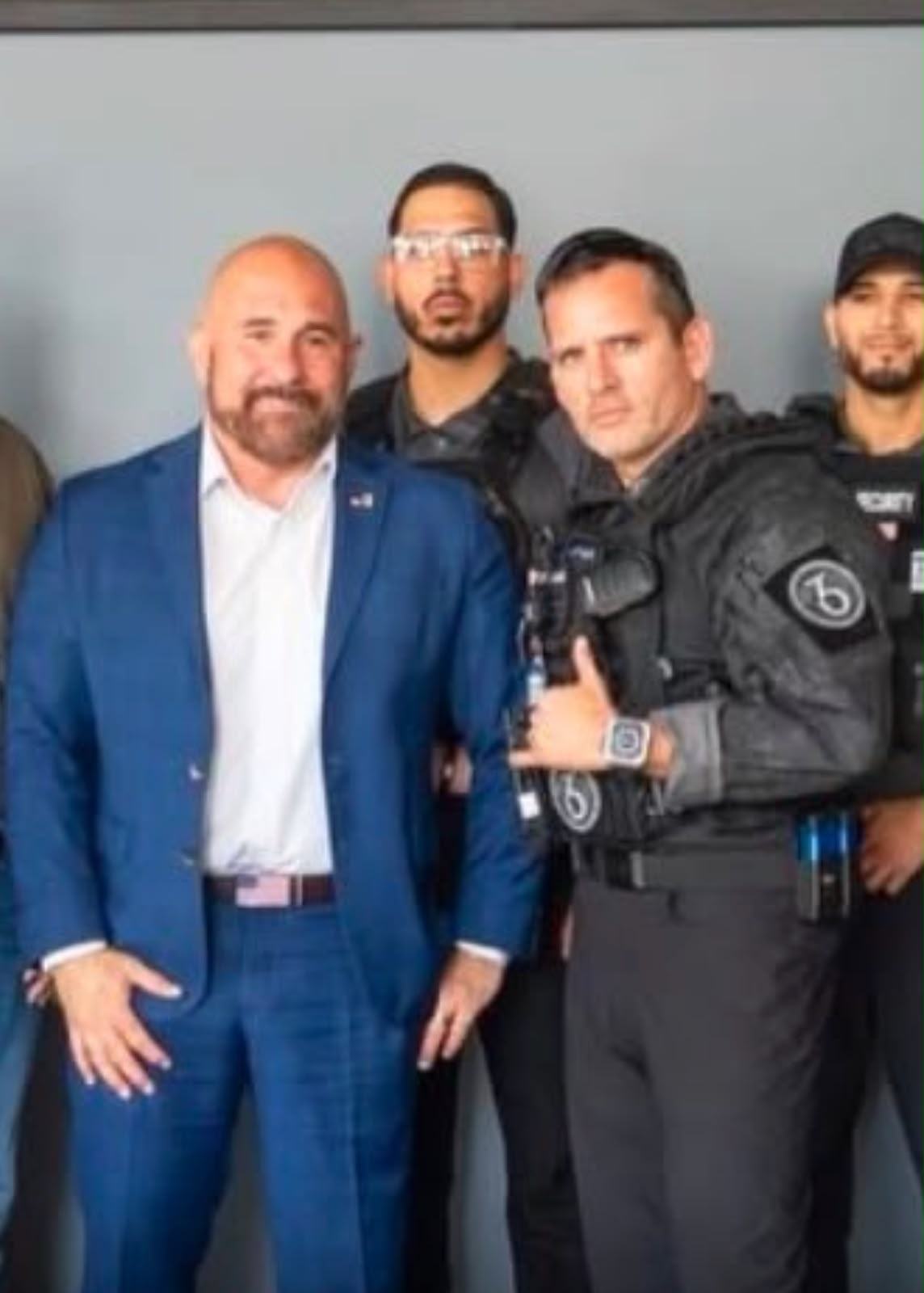
The 365 SMG team with Lt. Gov. Collins following the training evolution.
Our Thanks
Thank you to Lt. Gov. Collins for the time, the professionalism, and the genuine engagement with our team — and to Decision Tactical in Sanford for hosting. It is a real honor to train alongside someone who has carried the weight of both military service and public service.
If you or your organization want to train with us, visit the 365 SMG Academy or contact our team.