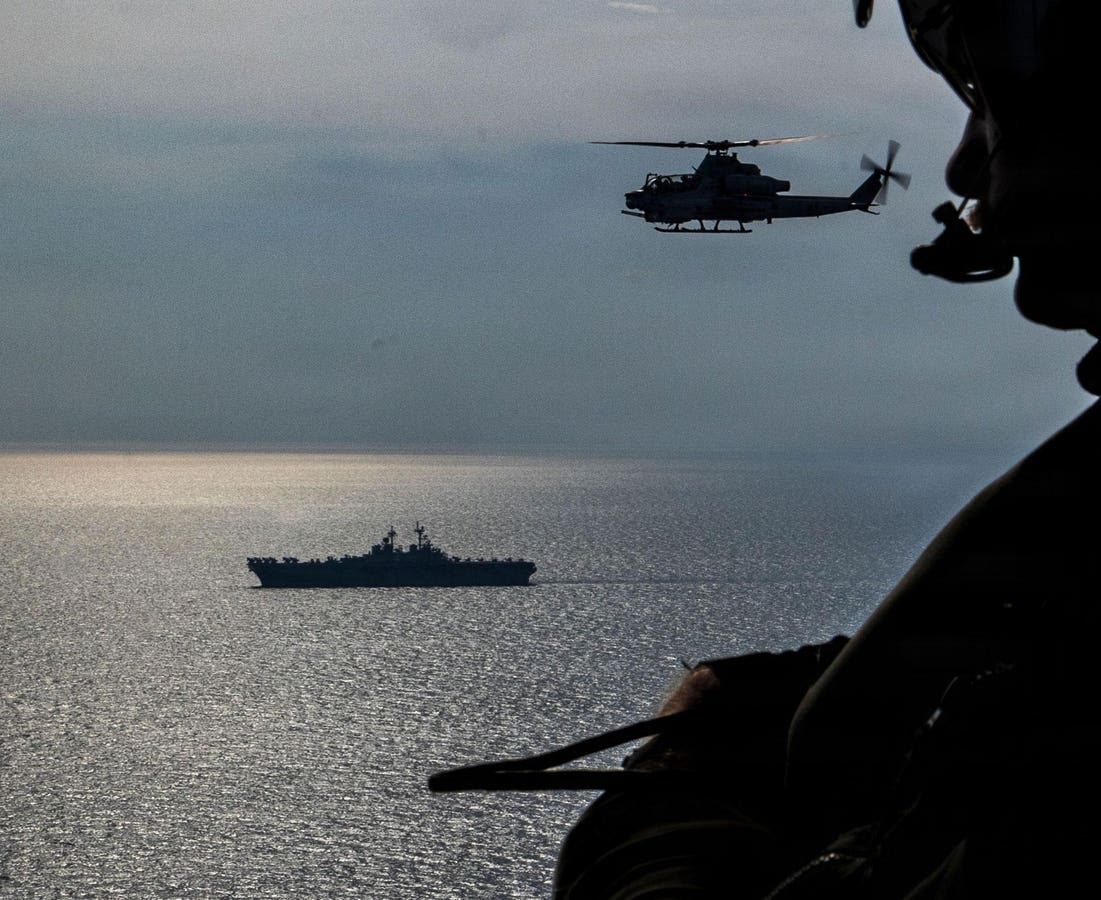
The U.S. Navy's Wasp-class amphibious assault ship USS Boxer (LHD 4), accompanied by the formidable 11th Marine Expeditionary Unit (MEU), has officially entered the U.S. 7th Fleet area of operations, navigating the strategically vital waters of the South China Sea. This deployment reaffirms America's steadfast commitment to international maritime security and stability in a region crucial for global commerce.
Often described as a "mini-aircraft carrier" or "flattop," the USS Boxer represents a pinnacle of naval engineering and versatility. These powerful amphibious assault ships are designed to embark, deploy, and land a Marine Expeditionary Unit, providing a full spectrum of capabilities from the sea. The Boxer is equipped to operate advanced aircraft like the F-35B Lightning II stealth fighters and a variety of helicopters, serving not only as a formidable combat platform but also as a sophisticated command-and-control center and a robust medical facility. It truly functions as a mobile, self-sustaining base, capable of executing diverse missions ranging from combat operations to critical humanitarian assistance.
Complementing the Boxer's impressive capabilities is the 11th Marine Expeditionary Unit. A MEU is a highly adaptable, self-contained fighting force, comprising ground, air, and logistics combat elements. This integrated force is trained and ready to execute missions across the full spectrum of military operations, making their presence aboard the Boxer a clear signal of comprehensive readiness and agile crisis response. They embody the professionalism and preparedness required to operate effectively in dynamic global environments.
The South China Sea is one of the world's most critical waterways, facilitating a significant portion of global maritime trade—a flow of goods and resources vital for economies worldwide, including our own. The consistent presence of U.S. Navy assets like the USS Boxer in international waters underscores a fundamental principle: freedom of navigation. This cornerstone of international law ensures open access for all nations to these vital passages. These operations are meticulously conducted to maintain stability, deter aggression, and uphold a rules-based international order, directly impacting the flow of everyday goods and resources that families and businesses rely upon daily.
For families and middle-class citizens, the strategic implications of deployments like the Boxer's might seem distant, yet their impact is profoundly tangible. The stability fostered by these operations helps secure the global supply chains that bring products to our stores, ensures energy security, and cultivates an environment where international commerce can thrive without disruption. Moreover, this deployment showcases the pinnacle of American technological prowess in defense and the unparalleled professionalism of our service members. These dedicated individuals are committed to protecting not just our nation's borders, but also the broader interests that contribute directly to our collective prosperity and safety at home. This is a testament to continuous vigilance and the strategic deployment of resources necessary to safeguard both global security and the fabric of our everyday lives.
In essence, the USS Boxer and the 11th MEU's presence in the U.S. 7th Fleet area of operations serves as a clear and powerful indicator of America's enduring commitment to peace, stability, and adherence to international law in crucial regions like the South China Sea. It represents a formidable demonstration of readiness, capability, and the essential role our military plays in navigating a complex global landscape, ultimately working towards a safer and more predictable world for everyone.
365 Intelligence
The Wasp-class amphibious assault ship USS Boxer (LHD-4), with the 11th Marine Expeditionary Unit, is now in the U.S. 7th Fleet area of operations
The U.S. Navy's Wasp-class amphibious assault ship USS Boxer (LHD 4), accompanied by the 11th Marine Expeditionary Unit, is now operating in the strategically vital South China Sea, reaffirming Ameri…
June 12, 2026·Sentry365 News Team·2 min read