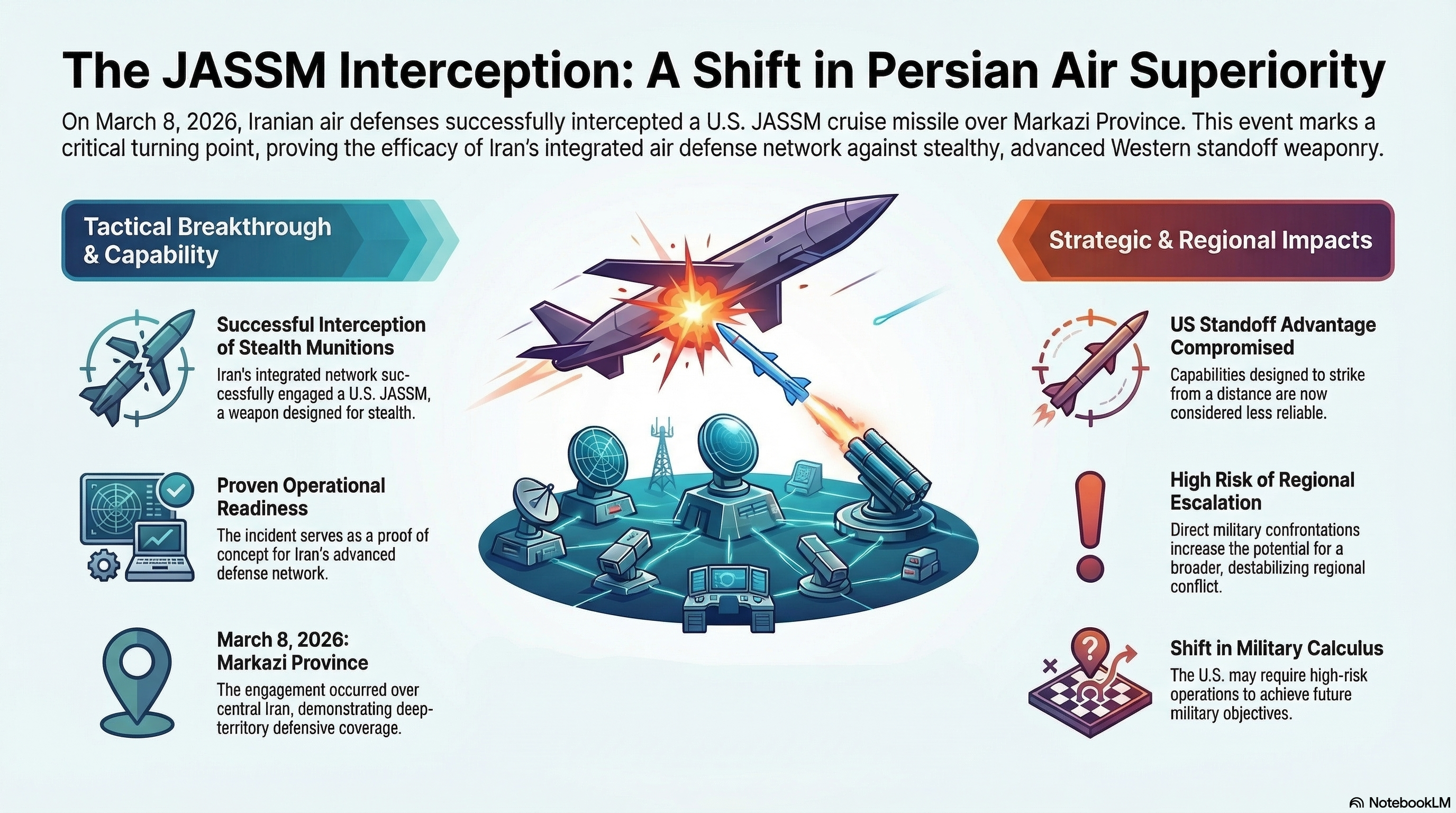
For over thirty years—an era of dominance stretching back to the opening sorties of Operation Desert Storm—Western military doctrine has rested upon a singular, unchallenged pillar: the perceived invincibility of "stealth" and "standoff" technology. The assumption was that low-observable platforms could penetrate any contested environment, allowing the United States to strike with impunity while remaining safely outside the reach of retaliatory fire. On March 8, 2026, that era of comfortable air supremacy effectively ended in the skies over Iran’s Markazi province.
I am currently reviewing a high-level Intelligence Summary, the timestamp reading "Signal Decay: 3m ago." The data is unambiguous: Iranian air defenses successfully executed a kinetic engagement against a U.S. JASSM (Joint Air-to-Surface Standoff Missile) cruise missile. While some may dismiss the loss of a single munition as a tactical anomaly, a senior strategic analysis reveals a much darker reality. This was not just a lucky shot; it was a catastrophic compromise of a multi-billion dollar stealth program and a definitive signal that the "sanctuary of distance" has been breached.
1. The Myth of the Untouchable Munition
The JASSM is the crown jewel of Western conventional strike capabilities, a weapon specifically engineered with Low-Observable (LO) features to ghost through the world's most sophisticated sensors. Its interception by Iran’s integrated air defense network (IADS) is a watershed moment in electronic warfare and kinetic interception.
While specific hardware remains classified in official reports, defense circles indicate that Tehran’s network—leveraging advanced phased-array radars and long-range interceptors likely derived from domestic platforms or Russian-origin S-300/S-400 analogs—has achieved a level of technical sophistication previously doubted by Western planners.
"This incident serves as a proof of concept for the operational readiness and capability of Iran's integrated air defense network... specifically highlighting their ability to successfully engage and intercept advanced Western munitions like the JASSM."
This is no longer a theoretical threat. It is a proven capability to track and neutralize "untrackable" targets. The "get out of jail free" card provided by stealth technology in this theater has officially expired.
2. Why "Striking from a Distance" Just Got More Dangerous
The erosion of "standoff" capability represents a fundamental crisis for U.S. military calculus. Standoff assets are designed to project power into Anti-Access/Area Denial (A2/AD) bubbles without risking pilots or high-value manned platforms. For decades, this provided a "low-risk" method for achieving strategic objectives.
The Markazi intercept confirms that these standoff capabilities are increasingly unreliable against a high-readiness adversary. When a stealthy cruise missile is intercepted, the safety of the distance from which it was launched becomes an illusion. We are witnessing a radical shift in the theater: to achieve objectives once considered routine, the U.S. must now consider more resource-intensive, high-risk operations. If LO munitions cannot guarantee penetration, commanders are forced to either saturate the environment with overwhelming force or put "skin in the game" by deploying manned assets into the teeth of an active A2/AD network.
3. Moving Beyond the Shadows: Direct Military Engagement
The historical paradigm of the "Gray-zone"—where Washington and Tehran traded blows through proxies like Hezbollah or the Houthis—is being replaced by a much more volatile reality. The shootdown over Markazi province marks a decisive transition from shadow boxing to direct military confrontation.
This was a state-on-state kinetic event. By directly targeting and neutralizing a frontline U.S. strategic asset, Tehran is signaling that the "layer of insulation" provided by proxy warfare has been stripped away. Without that buffer, every tactical engagement over Iranian soil carries the weight of a potential spark for a total regional conflagration. The insulation is gone; the actors are now face-to-face.
4. The Escalation Ladder is Losing Its Rungs
The Middle East security environment is currently characterized by extreme volatility. As I monitor the live feed, the intelligence report notes an "Expiry in 48h," underscoring the fleeting window for diplomatic de-escalation after such a high-stakes event.
The proven effectiveness of Iran's IADS directly counters the primary U.S. strategic objective of maintaining a stable and predictable security environment. This successful intercept emboldens regional actors and fundamentally alters the escalation ladder. When defensive networks prove they can stop the West’s "best" weapons, the deterrent value of those weapons vanishes. This creates a vacuum that is often filled by miscalculation and rapid, uncontrolled escalation, drawing in neighboring states and threatening to turn a localized intercept into a regional war.
Conclusion: The New Reality of the Middle Eastern Sky
The interception of a single JASSM over Markazi province is a klaxon for the end of Western technological exceptionalism. It serves notice that the integrated, high-readiness networks of our adversaries have caught up to the "invisible" spear.
The strategic landscape has been irrevocably altered. The platforms that once ensured contested-space penetration are being neutralized, and the "shadow war" has emerged into the unforgiving light of direct conflict.
In an era where "stealth" can be seen and "standoff" can be stopped, how must global powers redefine the meaning of deterrence?
365 Intelligence
The Shield of Tehran: Why the Recent JASSM Intercept is a Game-Changer for Global Security
The Shield of Tehran: Why the Recent JASSM Intercept is a Game-Changer for Global Security
March 8, 2026·365 Security Management Group, LLC·4 min read