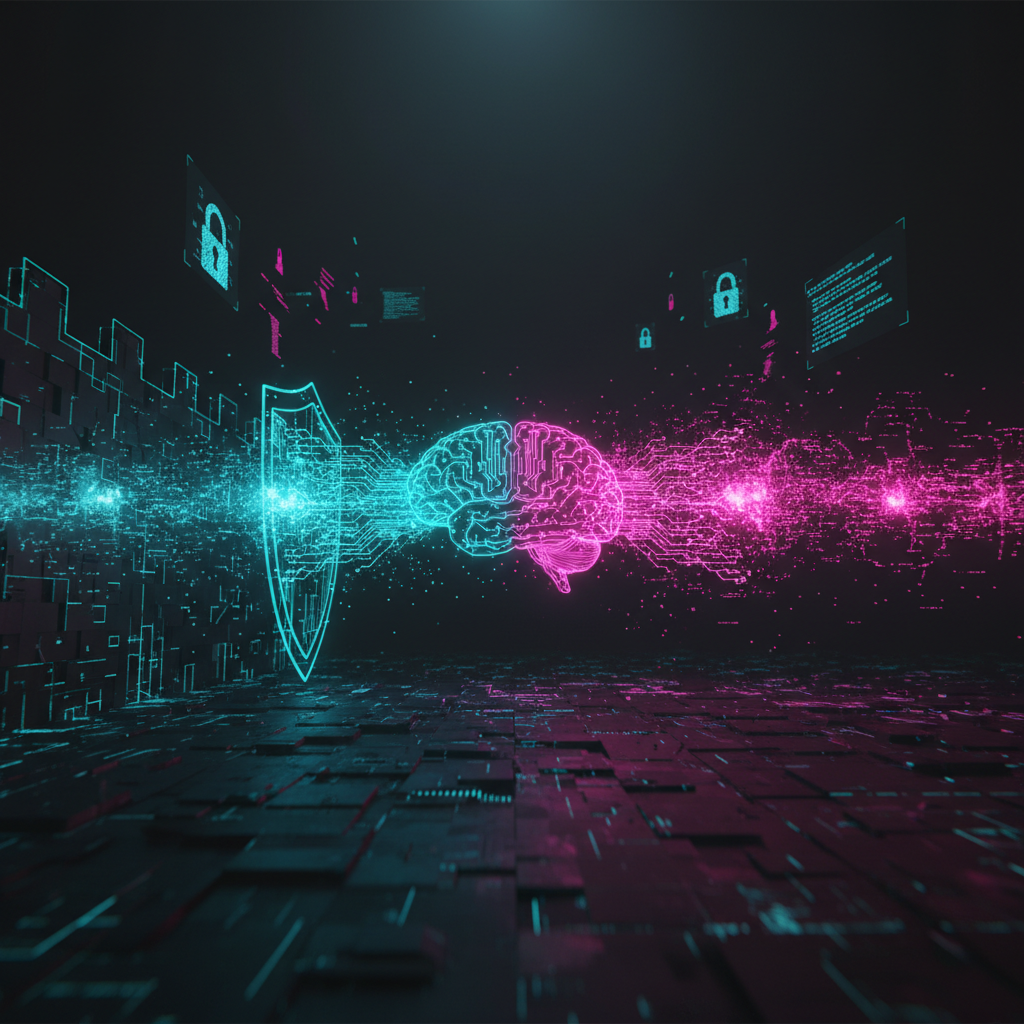
Artificial intelligence (AI) has rapidly ascended from theoretical concept to an indispensable tool across industries, and nowhere is its impact more profoundly felt than in cybersecurity. It presents a paradox: AI is simultaneously the most potent weapon in the cyber attacker's arsenal and the most sophisticated shield for defenders. Understanding this dual nature is crucial for technical professionals navigating the evolving threat landscape.
On the offensive front, AI is democratizing and supercharging cyberattacks. Large Language Models (LLMs) like GPT-4 are enabling threat actors, even those with limited technical skills, to craft highly convincing phishing emails, generate sophisticated malware variants, and develop exploit code at unprecedented speeds. This capability significantly lowers the barrier to entry for cybercriminals, allowing for the rapid creation of polymorphic malware that evades traditional signature-based detection, and hyper-personalized social engineering campaigns that exploit human vulnerabilities with greater precision. The sheer scale and adaptability that AI brings to these attacks mean that organizations face a torrent of more intelligent, dynamic, and difficult-to-detect threats.
Conversely, AI is also an indispensable ally for cybersecurity defenders. Machine learning algorithms excel at processing vast datasets to identify anomalous behavior, predict potential threats, and automate response actions with speeds impossible for human analysts. AI-powered security solutions can detect sophisticated zero-day exploits by recognizing deviations from normal system activity, analyze network traffic for indicators of compromise, and rapidly triage alerts, reducing the burden on Security Operations Centers (SOCs). Behavioral analytics driven by AI can distinguish legitimate user and device patterns from malicious intrusions, offering a proactive layer of defense. Furthermore, AI is critical in vulnerability management, helping identify weaknesses in code and infrastructure before they can be exploited.
The dynamic interaction between offensive and defensive AI creates a continuous 'arms race.' As attackers leverage AI to develop more sophisticated threats, defenders must equally advance their AI capabilities to counter them. This necessitates not only significant investment in AI-driven security tools but also a deep understanding of AI's principles and limitations by cybersecurity professionals. Training and upskilling are paramount to ensure that human expertise remains central to strategy, oversight, and the ethical deployment of AI in security.
The future of cybersecurity is inextricably linked with AI. While it presents formidable challenges through enhanced attack vectors, its capacity to automate detection, predict threats, and bolster defenses is equally transformative. Organizations must adopt a proactive, AI-informed strategy, investing in robust AI-driven security solutions while simultaneously fostering a workforce capable of harnessing AI's power and mitigating its risks. The battle for digital security will increasingly be fought and won by those who best understand and ethically wield the dual edge of artificial intelligence.
365 Intelligence
The Dual Edge of AI: Reshaping Cybersecurity's Battleground
Artificial intelligence is creating an unprecedented cybersecurity arms race, simultaneously empowering sophisticated attacks and fortifying advanced defenses against an evolving threat landscape.
February 9, 2026·Sentry365 News Team·2 min read