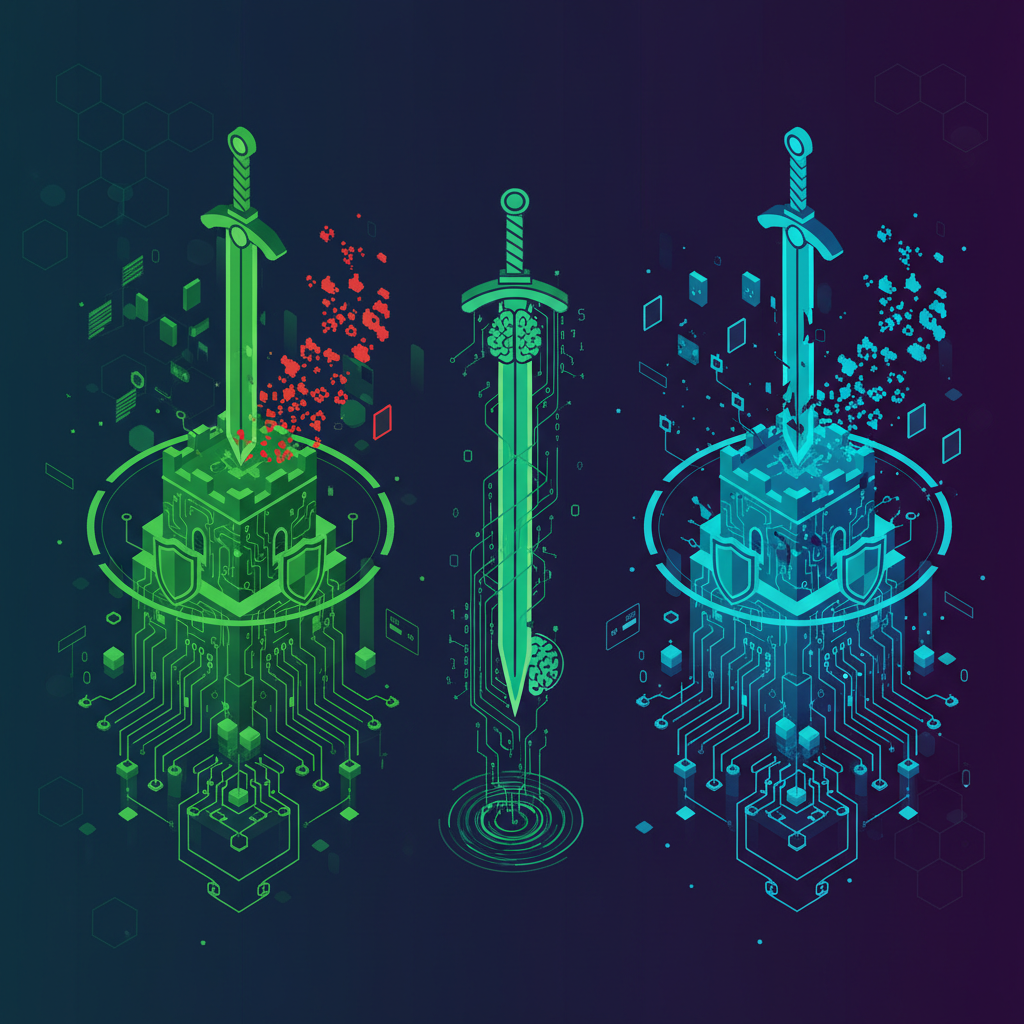
Artificial intelligence (AI) has rapidly become an indispensable force, reshaping industries and offering unprecedented capabilities. In cybersecurity, this transformative technology presents a profound paradox: it is simultaneously a formidable weapon for attackers and an invaluable shield for defenders. Understanding and strategically addressing this dual nature is paramount for technical professionals grappling with the evolving threat landscape.
AI as an Emerging Threat Vector
The integration of AI into critical systems has inadvertently expanded the attack surface, introducing novel vulnerabilities that traditional security measures are ill-equipped to handle. Malicious actors are already leveraging AI to orchestrate more sophisticated and evasive attacks:
Data Poisoning:
Adversaries can inject corrupt or manipulated data into AI training datasets, subtly altering model behavior to introduce backdoors, degrade accuracy, or facilitate misclassification, often with long-term, insidious effects.
Model Inversion Attacks:
Through careful analysis of an AI model's outputs, attackers can reconstruct sensitive information from its training data, posing significant privacy and confidentiality risks, particularly for models trained on proprietary or personal data.
Adversarial Attacks:
These involve crafting subtly perturbed inputs designed to trick AI models into making incorrect classifications or decisions. For instance, minor pixel changes in an image could cause an object recognition system to misidentify a stop sign, with potentially catastrophic real-world consequences.
Prompt Injection:
With the rise of Large Language Models (LLMs), prompt injection allows attackers to bypass safety filters or manipulate the model into revealing sensitive information, executing unintended code, or generating harmful content.
Generative AI Misuse:
Deepfakes and other forms of synthetic media are becoming increasingly convincing, enabling sophisticated phishing, social engineering, disinformation campaigns, and identity fraud that exploit human trust and bypass traditional authentication methods.
Supply Chain Vulnerabilities:
AI models often rely on complex pipelines, open-source libraries, and third-party components. A compromise at any point in this supply chain can introduce vulnerabilities, backdoors, or malicious logic into deployed AI systems.
Securing AI systems extends beyond typical network and application security; it demands a deep understanding of AI's unique vulnerabilities from design to deployment.
AI as a Strategic Defensive Ally
While AI introduces new threats, it simultaneously offers unparalleled opportunities to bolster cybersecurity defenses. Its ability to process and analyze vast quantities of data at speeds impossible for humans makes it an indispensable tool for detection, prediction, and response:
Enhanced Threat Detection and Prediction:
AI and machine learning algorithms excel at identifying anomalous patterns, indicators of compromise, and sophisticated threats (malware, phishing, insider threats) that might elude rule-based systems. By analyzing network traffic, user behavior, and system logs, AI can predict potential attacks before they fully manifest.
Automated Incident Response:
AI-powered Security Orchestration, Automation, and Response (SOAR) platforms can automate critical incident response tasks, such as isolating compromised systems, quarantining malware, applying patches, and escalating alerts, drastically reducing response times and minimizing damage.
Vulnerability Management:
AI can scan codebases and systems to identify vulnerabilities more rapidly and accurately than manual processes, prioritizing them based on potential impact and exploitability, thereby optimizing patching efforts.
Behavioral Analytics:
By establishing baselines of normal user and system behavior, AI can detect deviations indicative of account compromise, insider threats, or advanced persistent threats (APTs) in real-time.
Resource Optimization:
AI helps security teams combat alert fatigue by filtering out noise, correlating events, and providing actionable insights, allowing human analysts to focus on the most critical threats.
**Navigating the Dual Edge: A Strategic Imperative**
The dual nature of AI in cybersecurity necessitates a holistic and proactive approach. Organizations must embrace "security by design" principles, integrating robust security measures into every stage of AI development and deployment. This includes:
AI-Specific Security Frameworks:
Implementing frameworks that address unique AI vulnerabilities, such as robust data validation, model integrity checks, and adversarial training techniques.
Continuous Monitoring and Validation:
Regularly auditing AI models for drift, bias, and susceptibility to adversarial attacks, along with continuous monitoring of the data pipelines.
Human-AI Collaboration:
Leveraging AI for automation and analysis while maintaining human oversight for critical decision-making, ethical considerations, and complex threat hunting.
Ethical AI Development:
Prioritizing fairness, transparency, and accountability in AI systems to mitigate risks like algorithmic bias that could lead to security blind spots or misuse.
Adaptive Strategies:
The AI landscape is dynamic. Cybersecurity strategies must evolve continuously to counter new AI-driven attack methodologies and integrate the latest AI defensive innovations.
In conclusion, AI is not merely a tool but a paradigm shift in both offensive and defensive cybersecurity. Success hinges on a comprehensive understanding of its capabilities and risks, coupled with strategic implementation and unwavering vigilance. Organizations that proactively secure their AI systems and intelligently harness AI for defense will be best positioned to thrive in this new era of digital security.
365 Intelligence
The Double-Edged Sword: Navigating AI's Transformative Impact on Cybersecurity
Artificial intelligence is a double-edged sword in cybersecurity, introducing formidable new attack vectors while simultaneously offering indispensable capabilities for advanced threat detection and…
December 22, 2025·Sentry365 News Team·3 min read