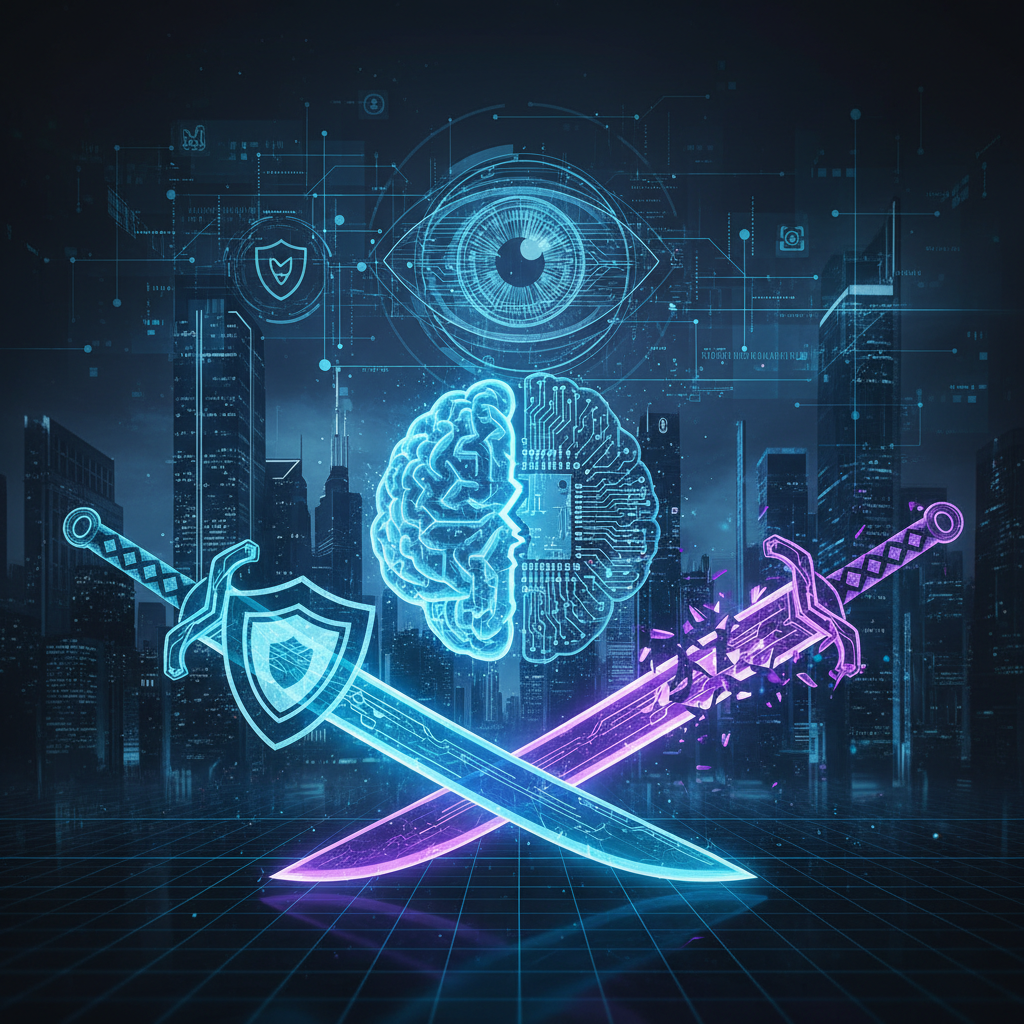
Artificial intelligence (AI) and machine learning (ML) are unequivocally transforming the cybersecurity landscape, moving from theoretical concepts to indispensable operational tools. This technological evolution presents a profound paradox: AI offers unparalleled capabilities to fortify defenses, yet simultaneously furnishes threat actors with sophisticated new weapons. For technical professionals, understanding and strategically addressing this double-edged sword is paramount.
**AI as the Defender's Unseen Ally**
The defensive applications of AI are revolutionizing security operations, enabling capabilities far beyond traditional signature-based detection. Organizations are leveraging AI to:
* **Elevate Threat Detection and Prediction:** AI algorithms excel at analyzing massive datasets—spanning network traffic, endpoint logs, and threat intelligence feeds—to identify anomalous behaviors and predict emerging threats with remarkable speed and accuracy. This capability is central to advanced Security Information and Event Management (SIEM), Endpoint Detection and Response (EDR), and Extended Detection and Response (XDR) platforms, enabling real-time threat correlation and contextual awareness.
* **Automate and Orchestrate Responses:** Security Orchestration, Automation, and Response (SOAR) solutions, powered by AI, automate repetitive tasks, streamline incident response workflows, and enable faster, more consistent remediation actions, significantly reducing mean time to respond (MTTR).
* **Proactive Vulnerability Management:** AI can rapidly identify software vulnerabilities, prioritize patching efforts based on potential impact, and even suggest mitigation strategies, moving organizations toward a more proactive security posture.
* **Fortify Insider Threat and Fraud Detection:** By establishing baselines of normal user behavior, AI can detect subtle deviations indicative of insider threats, account compromise, or fraudulent activities, providing early warnings before significant damage occurs.
**AI: A Formidable Weapon in the Attacker's Arsenal**
Concurrently, malicious actors are rapidly integrating AI into their operations, ushering in an era of more potent, evasive, and scalable attacks. The offensive applications of AI include:
* **Hyper-realistic Social Engineering:** AI-driven tools generate highly convincing deepfakes, voice impersonations, and sophisticated phishing campaigns that are virtually indistinguishable from legitimate communications, bypassing human discernment and traditional filters.
* **Evasive and Polymorphic Malware:** AI enables the creation of polymorphic malware that constantly alters its code, making signature-based detection incredibly challenging. It also assists in developing sophisticated evasion techniques designed to circumvent AI-powered defensive systems.
* **Automated Reconnaissance and Exploitation:** AI can automate target reconnaissance, identify exploitable vulnerabilities, and even autonomously craft tailored exploits, significantly accelerating attack cycles and lowering the skill barrier for complex operations.
* **Advanced Botnets and Distributed Attacks:** AI enhances the capabilities of botnets, enabling more intelligent and coordinated distributed denial-of-service (DDoS) attacks and credential stuffing campaigns.
**Navigating the Complexities: Emerging Challenges and Ethical Considerations**
The widespread adoption of AI in cybersecurity introduces a unique set of challenges that demand careful attention:
* **Adversarial AI Attacks:** A critical concern is the vulnerability of AI models to adversarial attacks. Malicious actors can "poison" training data or craft "adversarial examples" – subtle input perturbations designed to trick an AI model into misclassifying malicious activity as benign, or vice versa, thereby neutralizing defenses.
* **Bias and Explainability (XAI):** AI models can inherit biases from their training data, leading to blind spots in threat detection or disproportionate impact on certain user groups. Furthermore, the "black box" nature of many complex AI algorithms hinders explainability, making it difficult to understand why a specific decision was made, which is crucial for incident forensics, compliance, and auditing.
* **Data Integrity and Privacy:** The efficacy of AI is deeply dependent on vast amounts of high-quality data. Ensuring data integrity, protecting sensitive information used for training, and preventing data poisoning attacks are paramount.
* **Talent Gap:** A significant shortage exists for cybersecurity professionals with the requisite skills in both AI/ML principles and robust security practices to effectively deploy, manage, and secure AI-driven solutions.
* **Ethical AI Governance:** The deployment of powerful AI for surveillance, prediction, and automated response necessitates robust ethical frameworks and governance to ensure responsible, transparent, and compliant usage, avoiding potential misuse or unintended consequences.
**Strategies for a Secure AI-Driven Future**
To effectively navigate this evolving landscape, organizations must implement a comprehensive strategy:
1. **Secure AI by Design:** Integrate security principles throughout the entire AI development lifecycle, from data acquisition and model training to deployment, monitoring, and maintenance.
2. **Robust AI Security Measures:** Develop and deploy defenses specifically designed to protect AI systems against adversarial attacks, data poisoning, and model evasion techniques.
3. **Continuous Learning and Adaptation:** Security teams must cultivate a culture of continuous learning, staying abreast of rapid advancements in both defensive and offensive AI techniques.
4. **Ethical AI Frameworks:** Establish clear ethical guidelines and governance structures for AI deployment in cybersecurity, ensuring transparency, accountability, and adherence to legal and moral standards.
5. **Invest in AI-Literate Talent:** Bridge the talent gap by upskilling existing security professionals and recruiting individuals with expertise in both cybersecurity and AI/ML.
6. **Foster Collaboration:** Engage in cross-industry collaboration and information sharing with research institutions and government bodies to collectively address emerging AI-powered threats and develop best practices.
**Conclusion**
AI's integration into cybersecurity is an irreversible trend. While it provides an unprecedented strategic advantage to defenders, it equally empowers adversaries. Organizations that proactively understand AI's dual nature, secure its implementation, and invest in both the technology and the talent to wield it responsibly will be best positioned to thrive in this new era of digital security. The future of cybersecurity is intrinsically linked to our ability to master the double-edged sword of artificial intelligence.
365 Intelligence
The AI Paradox: Navigating the Double-Edged Sword in Cybersecurity
AI is fundamentally reshaping cybersecurity, acting as both a powerful defense mechanism and a sophisticated weapon for attackers, necessitating a strategic approach to navigate its complex dual-use…
April 4, 2026·Sentry365 News Team·4 min read