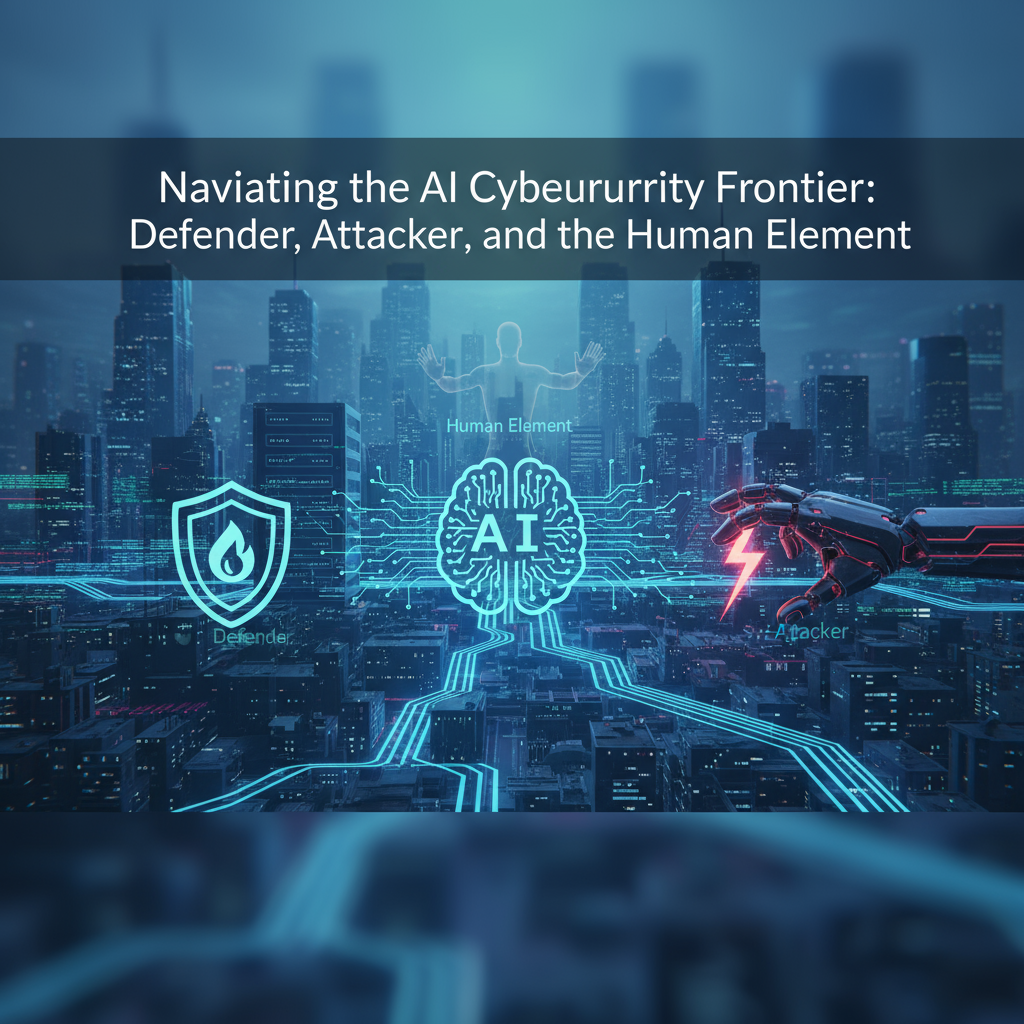
Artificial intelligence (AI) is rapidly transforming the cybersecurity landscape, presenting a paradox: it stands as both an indispensable ally in defense and a potent weapon in the arsenal of sophisticated adversaries. For technical professionals, understanding this duality and strategically integrating AI is paramount to building resilient security postures in an evolving threat environment.
On the defensive front, AI serves as a critical force multiplier, enhancing capabilities across the security operations center (SOC). AI-driven solutions are revolutionizing threat detection by processing vast datasets – far beyond human capacity – to identify anomalous behaviors, zero-day exploits, and advanced persistent threats with unprecedented speed and accuracy. Machine learning algorithms, foundational to modern security information and event management (SIEM) and endpoint detection and response (EDR) platforms, excel at pattern recognition, anomaly detection, and correlation of disparate events, significantly reducing mean time to detect (MTTD). Furthermore, AI automates aspects of incident response through security orchestration, automation, and response (SOAR) platforms, enabling rapid containment and remediation of threats, freeing up human analysts for more complex investigations and strategic initiatives. Predictive analytics, powered by AI, can even forecast potential attack vectors and vulnerabilities, shifting organizations towards a more proactive, threat-informed defense.
However, the same technological advancements that empower defenders are increasingly being weaponized by attackers. Adversaries are leveraging AI to craft highly sophisticated and evasive threats. Generative AI models facilitate the creation of hyper-realistic deepfakes and personalized phishing campaigns, drastically improving social engineering efficacy and making detection by human users or traditional filters significantly more challenging. AI can also be used to develop polymorphic malware capable of autonomously adapting its code to evade signature-based detection, making it notoriously difficult to trace and neutralize. Moreover, threat actors are employing AI for automated reconnaissance, vulnerability scanning, and even to generate novel exploit techniques, accelerating the speed and scale of their campaigns. The rise of adversarial machine learning attacks, where attackers manipulate training data or input to security models to trick them into misclassification or failure, adds another layer of complexity to AI-driven defenses.
The emerging cybersecurity frontier is thus characterized by an escalating AI 'arms race.' For organizations, merely adopting AI tools is insufficient; a strategic, nuanced approach is required. This involves not only deploying robust AI-powered defenses but also understanding the limitations of AI, including its susceptibility to bias and adversarial manipulation. Human oversight remains indispensable, as skilled cybersecurity professionals are needed to interpret AI outputs, validate alerts, refine models, and make critical decisions that AI alone cannot. Developing AI models that are resilient to adversarial attacks and continuously updating them against evolving threat patterns is crucial.
Ultimately, navigating this complex landscape demands a holistic strategy that fuses advanced AI capabilities with deep human intelligence. It requires continuous investment in both cutting-edge technology and the upskilling of security teams. By understanding AI's dual nature and strategically integrating it while maintaining robust human governance, technical professionals can forge stronger, more adaptive defenses against the sophisticated threats of today and tomorrow.
365 Intelligence
Navigating the AI Cybersecurity Frontier: Defender, Attacker, and the Human Element
AI is rapidly redefining the cybersecurity landscape, acting as both a powerful force multiplier for defense and a sophisticated tool for advanced threat actors, demanding a strategic blend of techno…
November 13, 2025·Sentry365 News Team·2 min read